

Dispatch from CHUKCHA
Hovercrafts and rein sleds, close encounters of the mammoth kind, literature of the Far North, curious colonial legacies, and more!

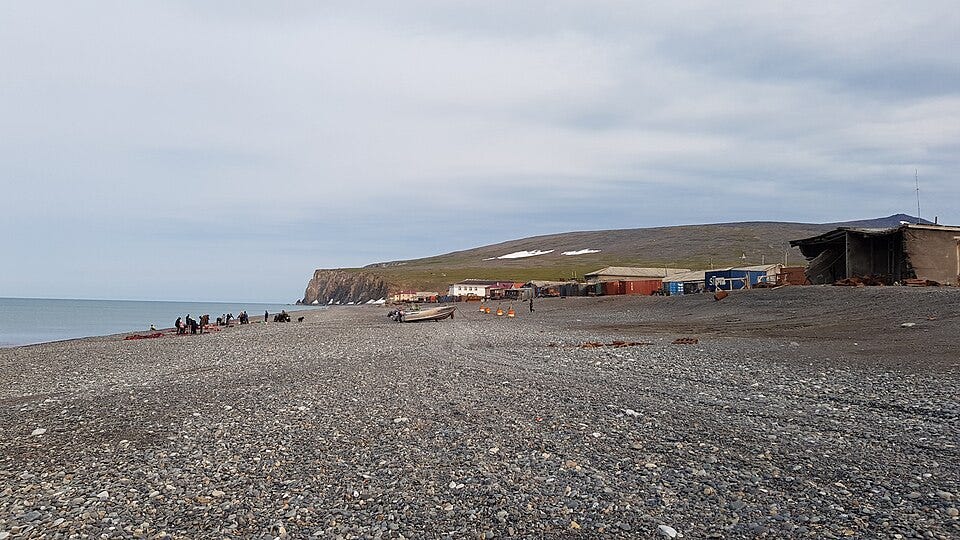
What a way to return to the eastern hemisphere! Few people are lucky enough to visit here, the farthest east of the Borealean continent. Getting to here, of course, is often the trouble. On our way over, our plane was grounded due to some “mechanical malfunction,” and we found ourselves temporarily stuck in the small coastal town of Nome, Yuka. With no other available flights to Chukcha, we had to get creative. We got seats in a small cargo plane to Ugurche, from which we took a hovercraft into Uelen. We managed to inform our contact before doing so, so our host was waiting for us on the beach at the end of the whole ordeal.
DISPATCH
“I like your style,” he said. Our contact was Dr. Zorawar Singh Pancapside, a Punjabi-born Californian exploration geologist with Chukcha’s national mining company. He has been living and working in the country for over three decades. Contrary to Adiittsii’s comments, our method of transportation here was most definitely not by rein sled. He was, however, right about the cold — freezing! Even this late in April, it was only a high of -10°C.
We quickly dove into our host’s massive off-road van. As we got changed into warmer clothes that he picked out for us, Zorawar explained that the Haidanese and other people from Wakasan have a friendly rivalry with the peoples on the other side of the Pacific, such as the Chukchese, meaning they trade barbs as much as they trade goods. Relatively few people in Chukcha today live off of rein herding, but those who do are still important to the local economy, with their large herds being the source of much of the people’s food.
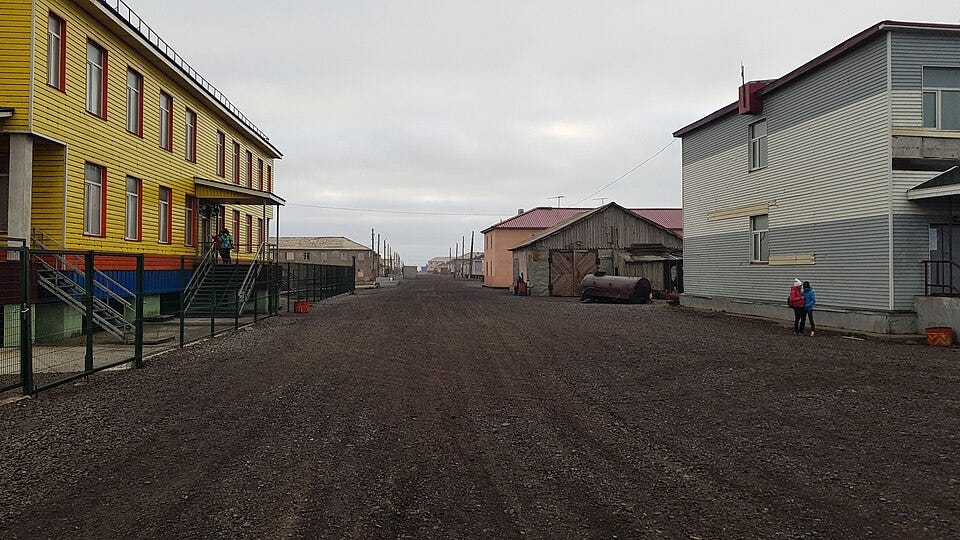
“What do you think of Uelen, Chukcha’s premier holiday beach town?” Zorwar said, as he drove us into town. In comparison to comparable seaside towns in Haida, the architecture in Uelen is much more functional. We passed by large blocks of buildings, multicoloured to contrast with the wintery landscape. At times, the colours blurred, as there was a thin veil of icy fog that hovered in the streets between the buildings. Zorward explained that this often occurred as temperatures yielded to change. Spring was on its way.
“Most of these were built during the Japanese period,” he said. Originally, Uelen was a sleepy seaside fishing village at the edge of the polar steppe. The maritime Chukchese, also known as the Anqallyt, lived in yurt-like yarangas, and traded with the rein-herding Chukchese that inhabited the interior, the Chavchy. “During colonialism, this became a huge hub for the ivory trade and mining.” Mining is still important here, but the mammoths and walruses of the north are no longer valued just for their tusks, but instead are Chukcha’s greatest tourist attraction. As such, Uelen has turned into something of a tourist Mecca of the Arctic, with its population of eight thousand permanent residents quadrupling in the summer months.
At Zorawar’s apartment, we were greeted warmly by Dr. Anqallyt Tegrynkau Ryltune, a noted biologist who does conservation work at the Chukchese Mammoth Steppe National Park. She also happens to be his wife. They’d been together for two decades. “A conservation biologist and a geologist working in mining make a good pairing. Many have speculated on what our marital fights must be like!” Ryltune joked, “but the fact is that mining has enabled Chukcha to maintain its economic independence, and this prosperity has allowed us to have the largest non-SoN mammoth conservation efforts in the world.”
She served us cups of refreshing lamekh, a type of hora, or dairy-based booze, a foodway brought over by the hordes of Yukagho-Mongolic and Turkic conquerors of old. Today it is fermented using rein milk mixed with mare, pog, and inaga milk. It typically has a low alcohol content, so it is drunk with nearly every meal, similar to the small beers of the West. We were then treated to a proper home-cooked meal: a stew of various tubers, including popoq (Claytonia acutifolia), ulqit (Claytonia tuberosa), and sagasokhuk (Gagea granulosa). The first two reminded us of potatoes, whilst the latter tasted onion-like.
All the food was seasoned with soy sauce, sorrel, and a touch of powdery dried rein blood. “Those are the flavours of Chukcha,” said Zorawar. Even in the coastal and riverside towns, which primarily eat seafood, most people use the dried blood for its flavour as much as for its thickening and binding properties.
Our soup was also accompanied by grilled fish, including Arctic char, keta salmon, and a large lakefish known as nelma. Just as we thought we had our fill, Ryltune brought out some pit-fermented boucon — meat from the oghat, the gentle giants found in Chukchese bays like herds of sea cows. Zorawar explained that the meat of oghat is so naturally salty it practically cures itself. “Neither of us can speak to this, but we’ve been told it tastes like corned beef,” added Ryltune.
After dinner, we had a good night’s sleep by our own crackling stove, an heirloom of Ryltune’s family from the time of the Russians. “We do not easily let go the disparate relics of our many pasts,” she had said with a smirk as she lit the fire for us.
We awoke early the next day to cups of chaypat, that is, tea, which was served from a samovar, piping hot — legacies of trade and empire — which were served with salted rein butter, a local flair. Ryltune handed each of us our own pack of ikiilgy — frozen balon and blubber — to take with us, as well as giant thermoses with more butter tea.
When we stepped out of the apartment building, the sun was high in the blue sky already, despite it being early in the morning. And Zorawar was also already out, packing the van. “The forecast is good. Perfect weather to go ranging in the polar steppe,” he said.
Little to no roads actually cross the steppe in Chukcha. Most towns are connected by snowmobile, hovercraft, and chartered plane service. Because of this, the all-terrain vehicle was handy, allowing us to drive for hours along a frozen dirt track.
After half a day of being tossed around in the vehicle, we arrived at an observation centre that was bursting with eager park rangers. Most of them were locals from herding backgrounds, but some were starry-eyed transplants from Chernorus and even as far as Japan and Swedeland. Most people travel through the Chukchese Mammoth Steppe National Park by snowmobile, but here, Zorawar revealed a surprise: he is actually able to pilot a traditional sled, which meant we would get to travel by the traditional Chukchese mode after all.
Our destination was a yaranga an hour away, used by the rangers as a rest stop on their patrols for observing the fauna. After a quick meet-and-greet with our teams of reins, we packed into the large sled and bundled up under fur blankets. “You see mammoths first here,” a Chernorusian ranger said in English. Seeing that we didn’t get his reference, he pointed at the fur and winked.
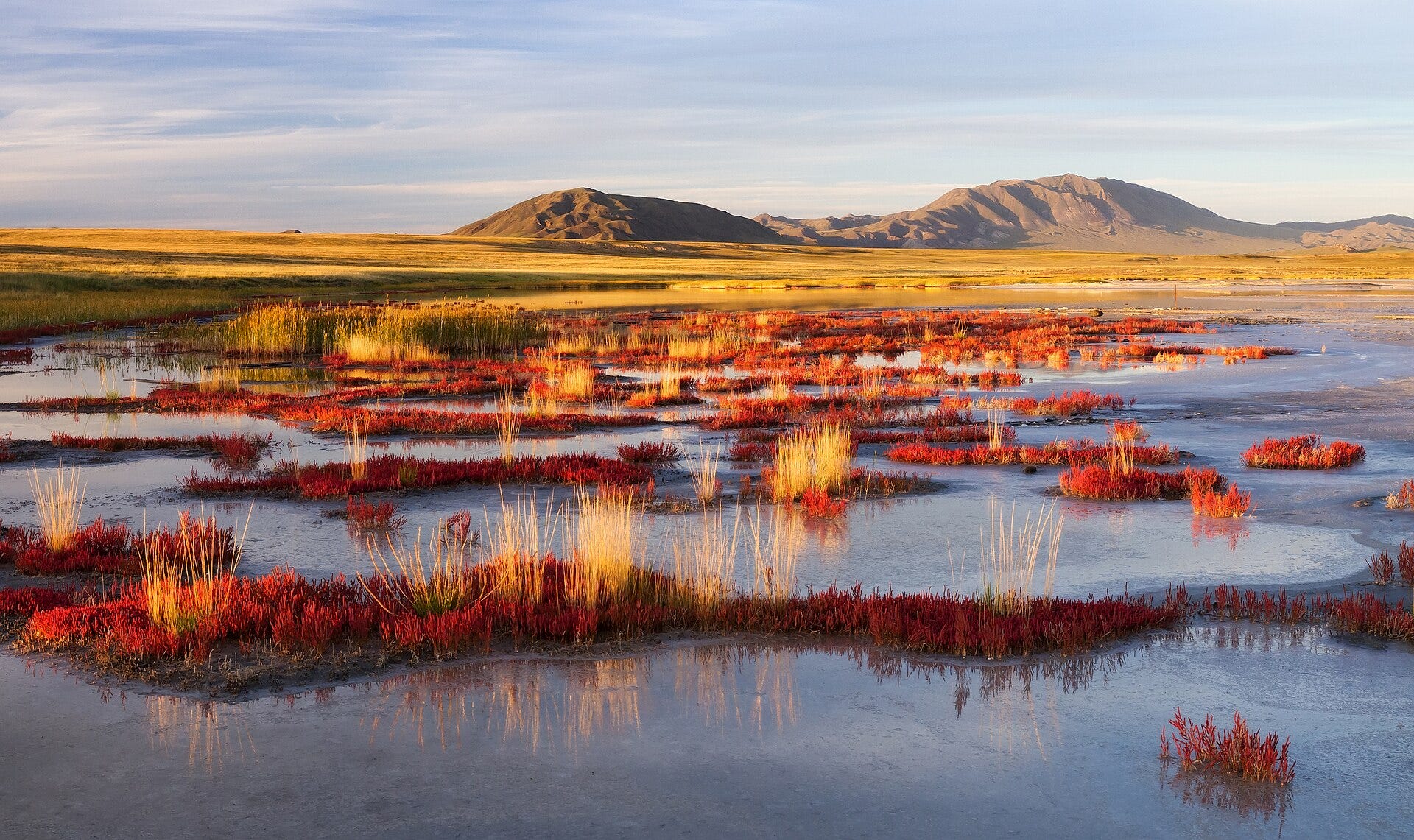
The cold wind whipped across our faces relentlessly, but the landscape of ice-capped mountains and pristine steppe was worth it. When we arrived at the Chukchese answer to the yurt, the sun was starting to set, so we settled in for the evening. Before turning in, we played a couple rounds of go, a game neither of us ever foresaw as something we’d be playing with a Punjabi-born Californian in the High Arctic. “Long winters,” Zorawar said after beating each of us.
I awoke early next morning, just in time to see what I thought was the last wisps of polar fog evaporate. Just then, two woolly giants appeared before me. Their breathing alone generated huge plumes of warm condensate. “It seems we won’t have to go looking for the mammoths,” Zorawar said from behind me.
We all hunched at the opening of the yaranga in awe, as if prostrating before higher beings. With a quick wag of his finger, Zorawar dashed our hopes of photographing the majestic animals. “You’ll frighten the younger one,” he whispered.
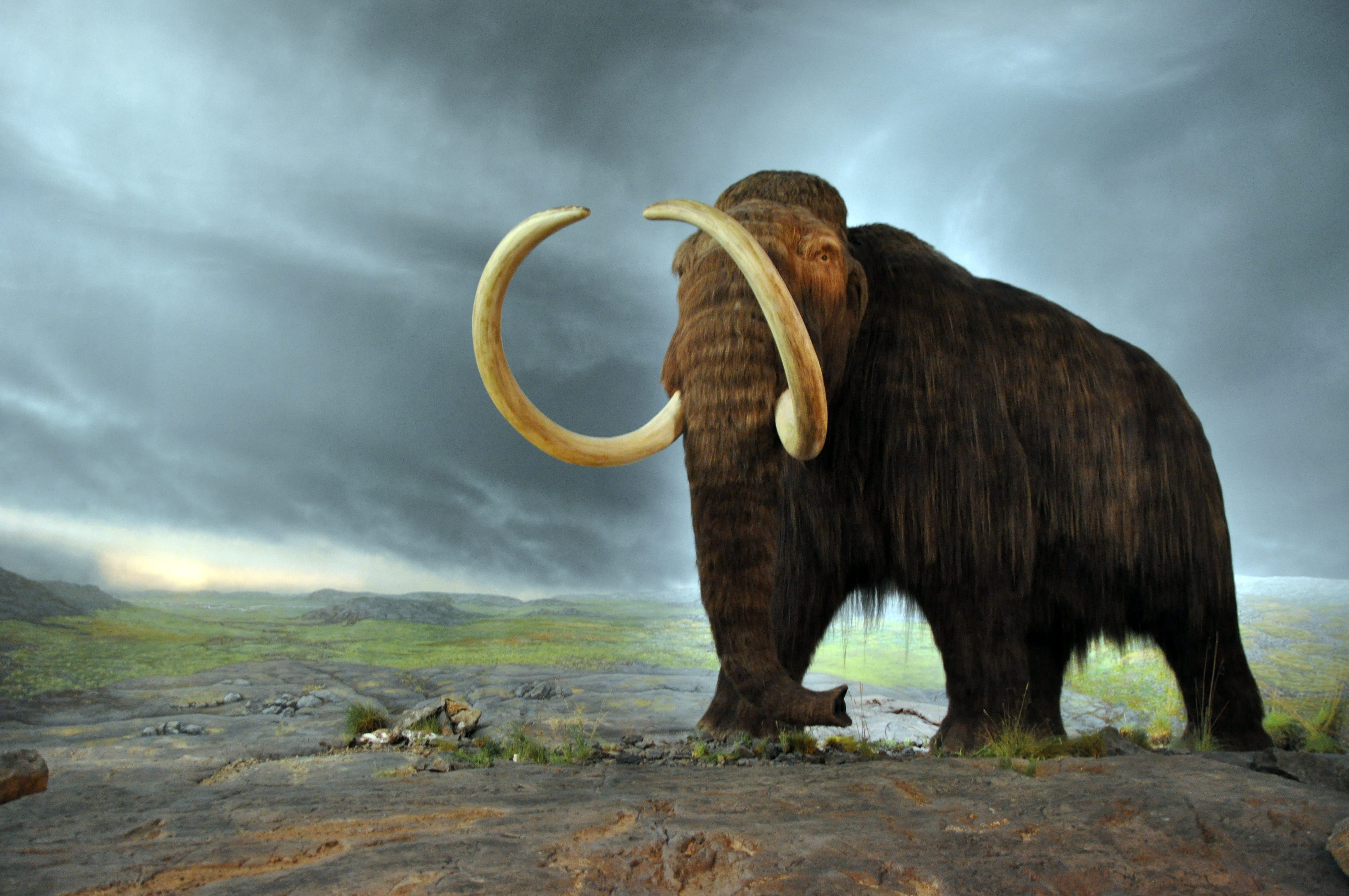
Zorawar later explained that mammoths are essentially semi-domesticated due to their complex relationship to humans. They were ferried over to the mainland from Mammoth Island by ancient Siberean herders — who exactly did it, how they did it, and for what reason, are still mysteries. Just as their elephant cousins in the south, however, they were never reared in captivity. Instead, the animals roamed with other grazers in the great herds of the last stretch of polar steppe in Borealea. People would capture young calves and break them into docility. Oral histories and records depict their brawn being applied by humans for logging, mining, and war — they were, after all, famously part of the Yukaghir horde that conquered the lands of modern-day Yuka. They were also important status symbols, kept by the khans of various empires that formed in Tunguska.
Chukcha is one of the few places in the world where mammoths can be seen in the wild, apart from Mammoth Island, which is strictly locked down by the SoN to preserve its fragile ecosystem. As per the national park’s rules, we did not go up and touch the mammoths. They can, however, come up to us. We were all suddenly grateful for the fence around the yaranga, especially after reconfirming with the host rangers that it was electric.
We stayed still as a mother and her calf approached us. Following Zorawar’s lead, we let the inquisitive calf smell our outstretched hands with its trunk. Zorawar ripped out a bundle of dried grass, which had been spared from grazing thanks to the fence, and passed it to me to hand over to the calf. It was absolutely one of the best moments of my life to see it chew the bundle of golden stalks. “The rangers don’t normally condone close encounters of this sort,” Zorawar said. “But what are we to do? The big fellas obviously missed a spot in their grazing. We’re just helping them remedy the oversight.”
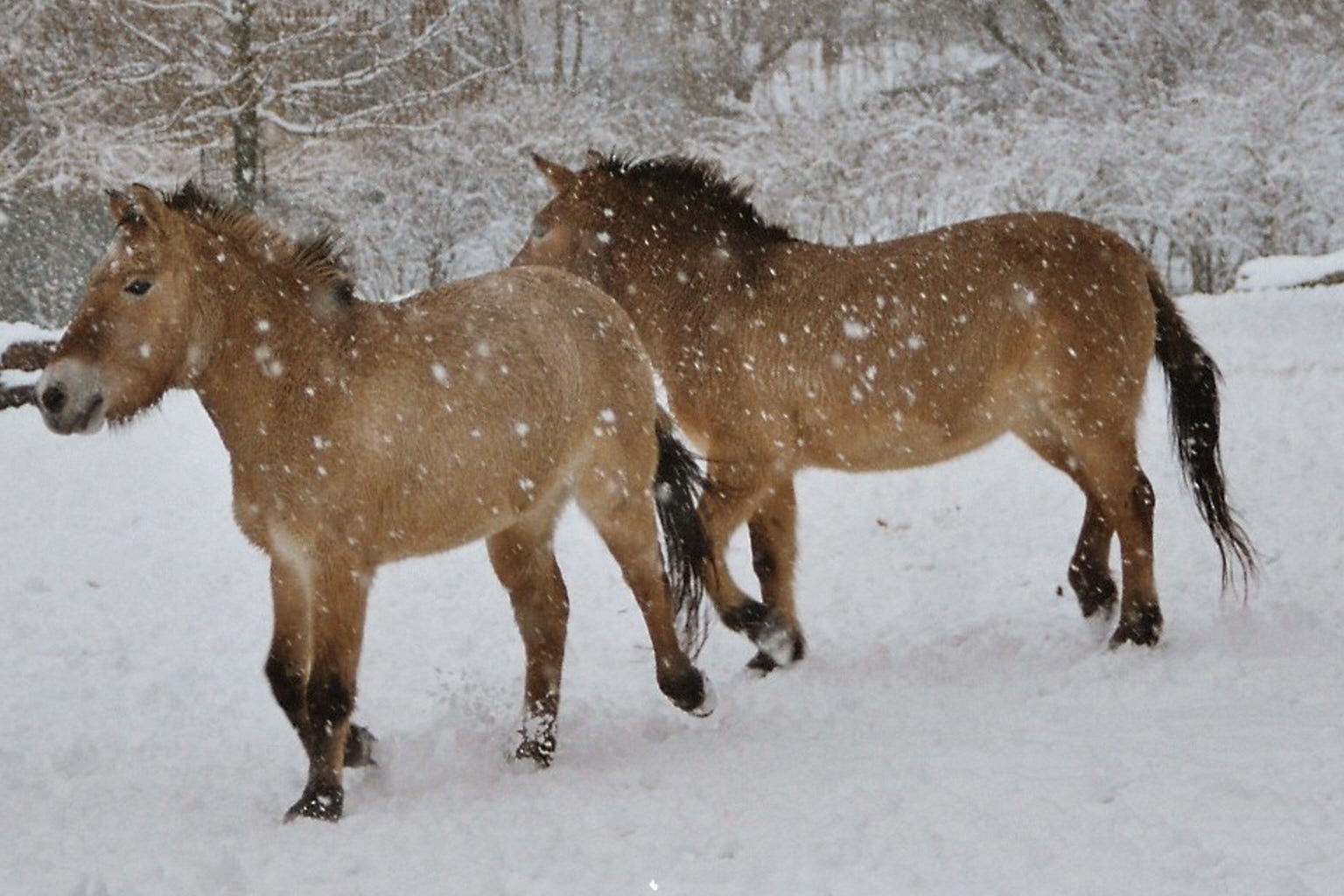
After watching the mammoths ambulate off to rejoin their herd in the far distance, we got back into the sled and headed out to an observation deck built to tower over a vast floodplain, which was starting to run with the spring melt. With binoculars, we stared at a pair of cave lions lazing about in the snow, steam rising from their backs. Not far were mixed herds of caribou, steppe tatankas, takhis, and umingmaks — wild counterparts to the reins, cozus, horses, and pogs traditionally herded by the Chukchese. “If my wife were here right now, she’d tell you that the survival of these animals in this remote corner of Borealea is probably the reason for the persistence of this rarest of biomes,” Zorawar said.
All we could think about, however, was why we never invested in better camera gear. “Don’t worry,” Zorawar said. “There’s always someone else’s shot. The Painted Earth Society had a team here just last week to take take photos and film a documentary.”
By the time we arrive back in Uelen, it was nightfall and we were exhausted! We slept a solid nine hours, knowing that Zorawar’s itinerary for us had us taking a plane the very next evening.
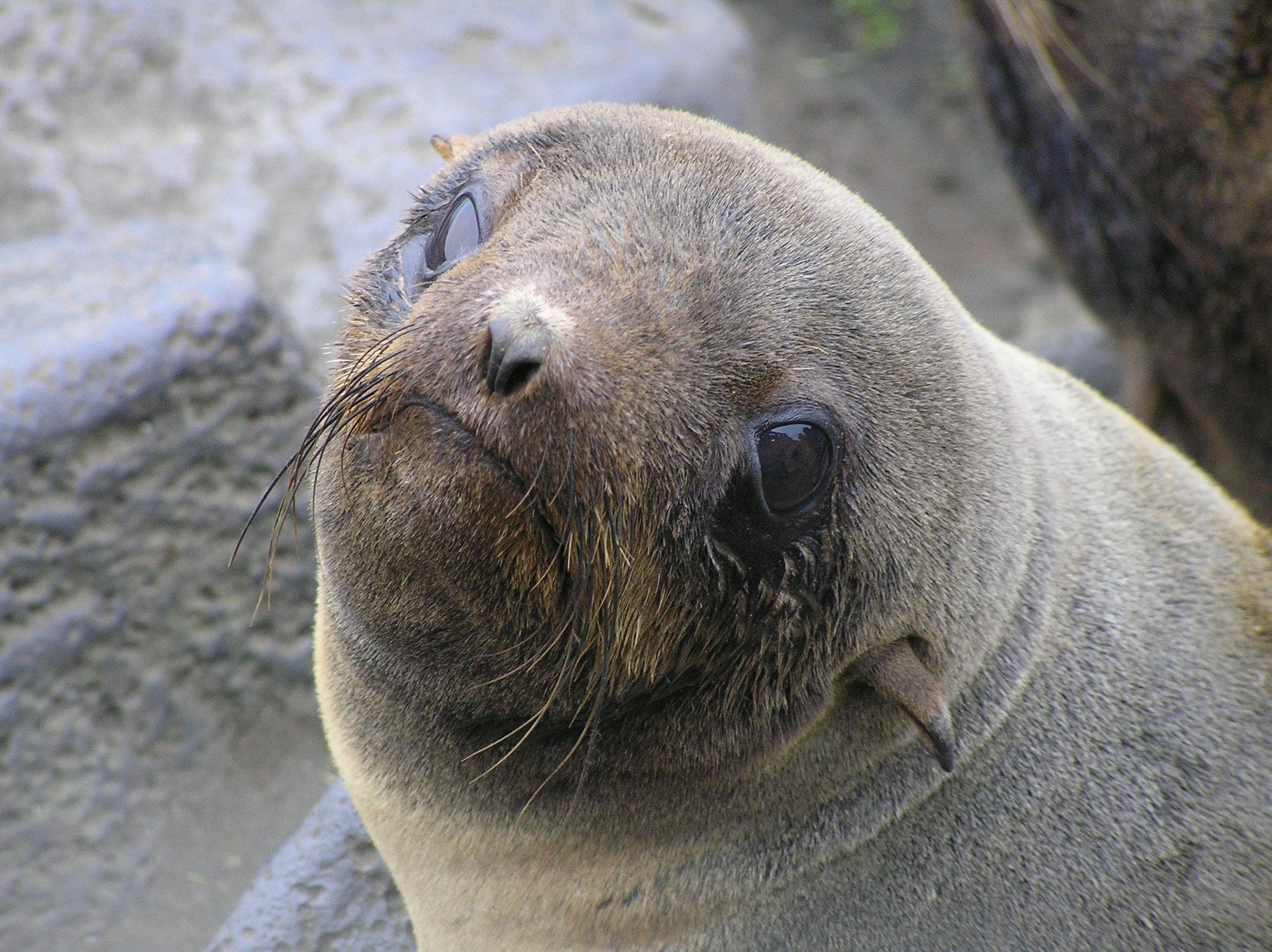
On our last day in Uelen, we were treated to a surprise boat tour of the marine wildlife the town is famous for. We had the opportunity to get up close and personal with wild otareys, seals, and walruses basking on the edge of skerries and remote beaches.
Ryltune, who had joined us on the boat, told us that in older times, these animals would all have been fair game for hunting. “My genonym, Anqallyt, refers to the coastal clan of the northern Chukchese,” she said. “Even today, our diet includes fucon and boucon, meat from marine mammals. But, we rarely hunt, as the domesticated varieties, what you call goons and rones in your language, are farmed and ranched in great numbers here.”
Then Ryltune pointed towards the horizon, where silhouettes of kayakers could be seen. “Those men are herding oghats. These docile creatures might as well be considered domesticated,” she said. “There are no wild populations left.”
We also learned that hunting is still done, but primarily for cultural reasons. Chukcha even holds annual whale hunts, done communally, while still being a member of the International Whaling Commission. The process for getting a hunting license for most urban folks is quite strict, as Chukcha has really embraced ecotourism as a path to securing a sustainable and prosperous future. This means that, along with the pinnipeds lounging near Uelen, even the furry sea otter gets a free pass, often seen hanging around the marina in little rafts or holding hands.
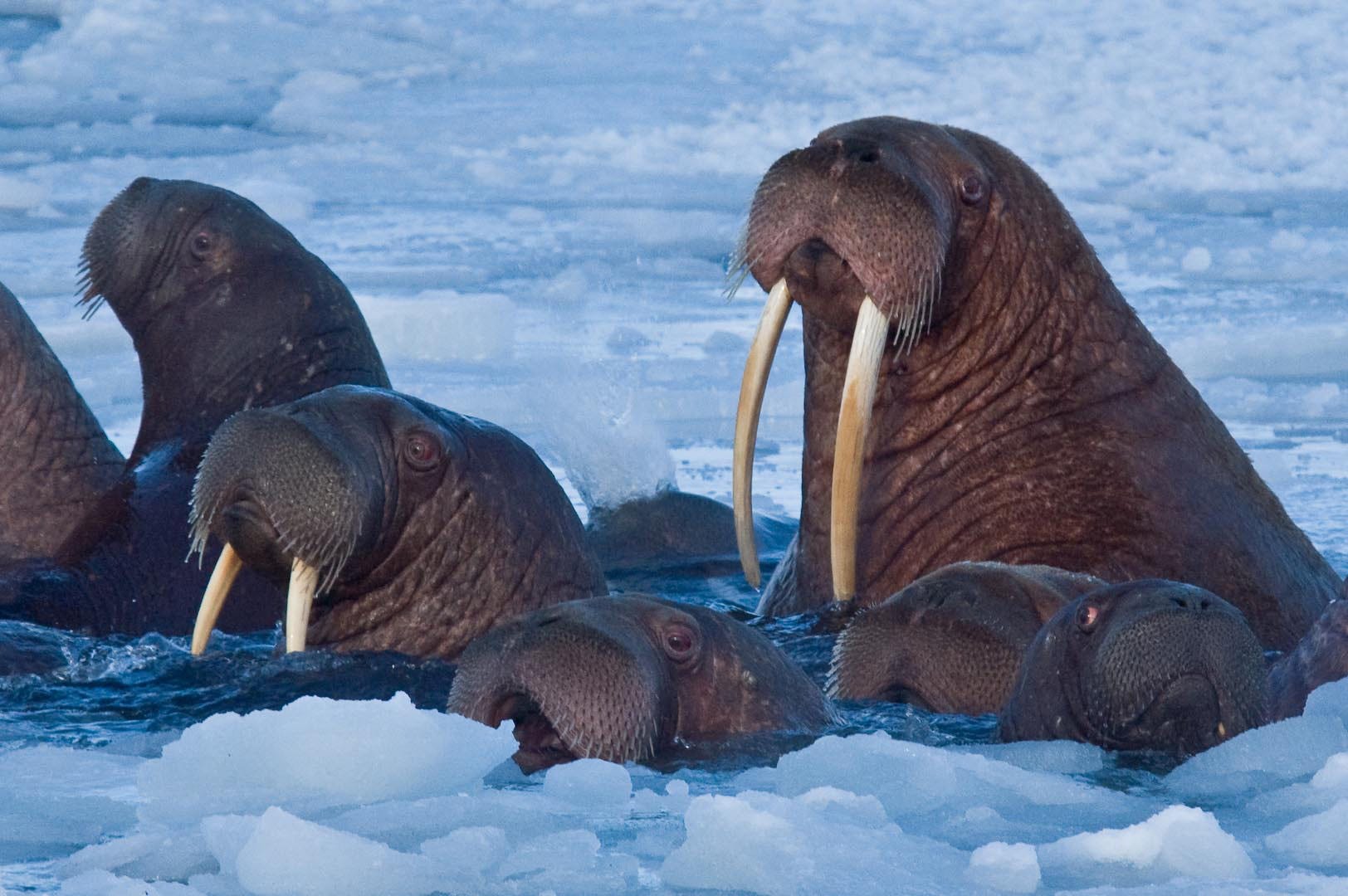
At the end of the tour, Zorawar was even able able to spot a couple of orcas in the distance. We stared nervously as a pair of giant dorsal fins made directly towards an unlucky seal caught out in the open. There was a lot of thrashing in the water, but in the end, we couldn’t make out the result. “I’ve learned to not root for any outcome in cases like this,” Ryltune said.
Later that evening, we boarded a small commercial flight to take us to the southern city of Rytkheu, known for being the cultural hub of the country. Zorawar had to go back to work, but we were lucky to be accompanied by Ryltune. “I’m always keen to find an excuse to visit my hometown,” she said.
Rytkheu is as far south as Chukcha goes. The ground was mostly clear of snow, and some of the urban trees even had visible green buds. We were picked up by Ryltune’s sister, Galgannga, who took us to their family home, a spacious and well appointed apartment with several rooms, enough for a large family.
The next day, we decide to do a walking tour, taking advantage of the sunlight and temperature high of -1°C. We got mugs of smoky lapsang chay, a kind of smoked tea popular throughout Chernorus and Tunguska. Galgannga encouraged us to drink it mixed with pog milk. It was a joy to sip the smoky and creamy richness as we walked through the brightly coloured streets of the city.
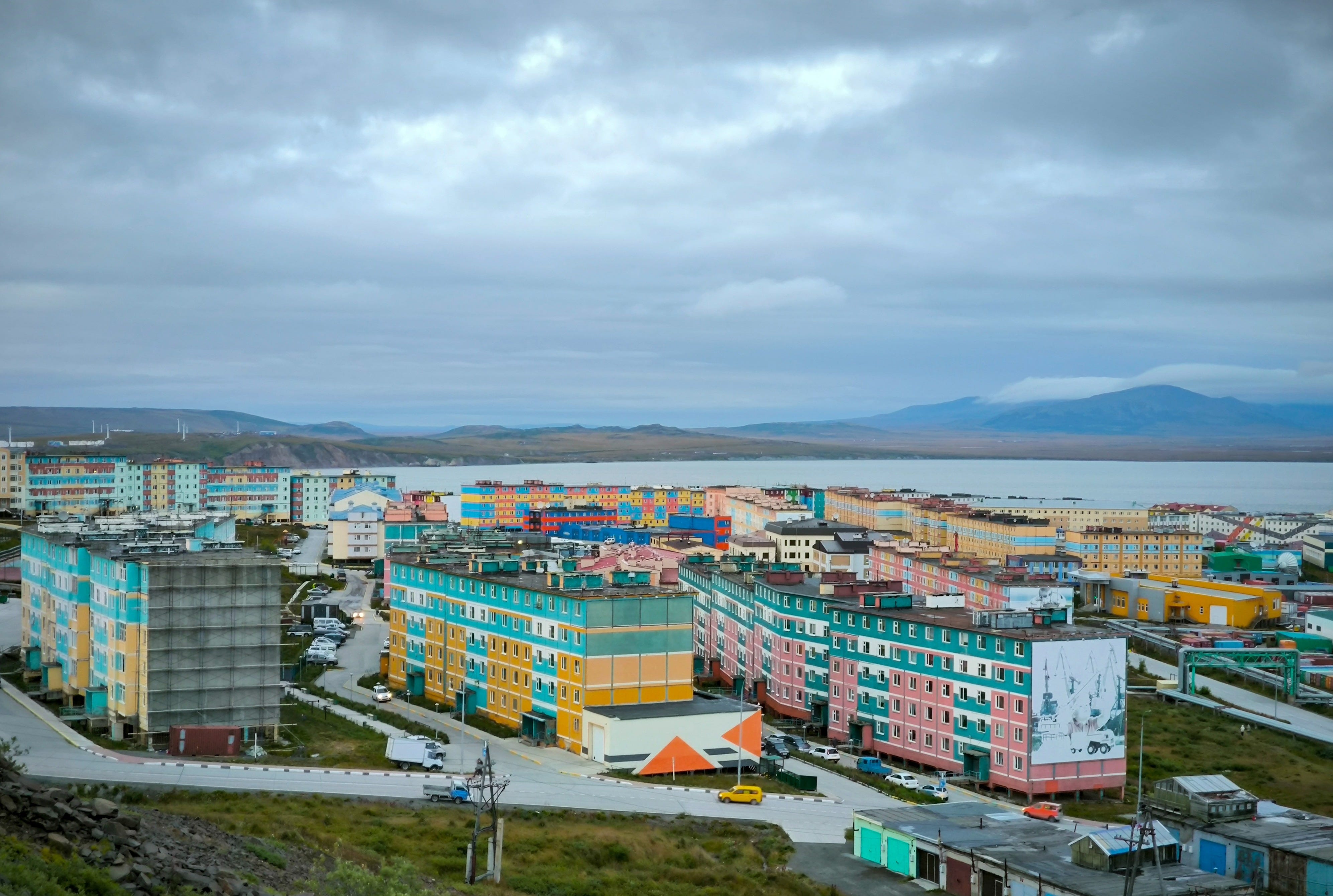
With 135,000 people nested in the valley of the Vykvulgayat River, Rytkheu accounts for over half of the country’s population. Formerly known as Port Kereku, the city is the first port to thaw in the winter, and it was the old capital from the establishment of colonial rule until 1989, when construction finished for Kargyryn, the contemporary capital. Rytkheu, however, still maintains itself as the economic and cultural capital of Chukcha, with the main university located here, and the largest attraction being the expansive Museum of Siberian Literature.
Galgannga explained to us that the site of the city itself has long been inhabited by the Angqalgakku clan of the Chukchese people, but it was transformed from a coastal village into the largest city of her people when it became the site of a Russian fort, Ostrog Kerekev. Though the fort walls were razed during the Japanese period, many of its buildings were repurposed, and its old Orthodox church was left untouched.
After being repurposed as military barracks, and later as a government archive, much of the fort lands were redeveloped to its current form, as a grand museum. This happened under the direction of the first president and revolutionary of the country, Anqallyt Sergey Rytkheu, who many people outside of the country know more as the famous author of A Dream in Polar Fog. The novel was one of the first to be written entirely in Chukchese, using the city’s koiné that would later become the basis for the standardized language. Modern Chukchese includes influences of the local Kereku dialect, along with the Uelen, Vatyrkan and Chomparna dialects — where most of the city’s workers migrated from — as well as some influence from the Chuvan language, an endangered Etelic language spoken by a few herding communities close to the Kolmese border.
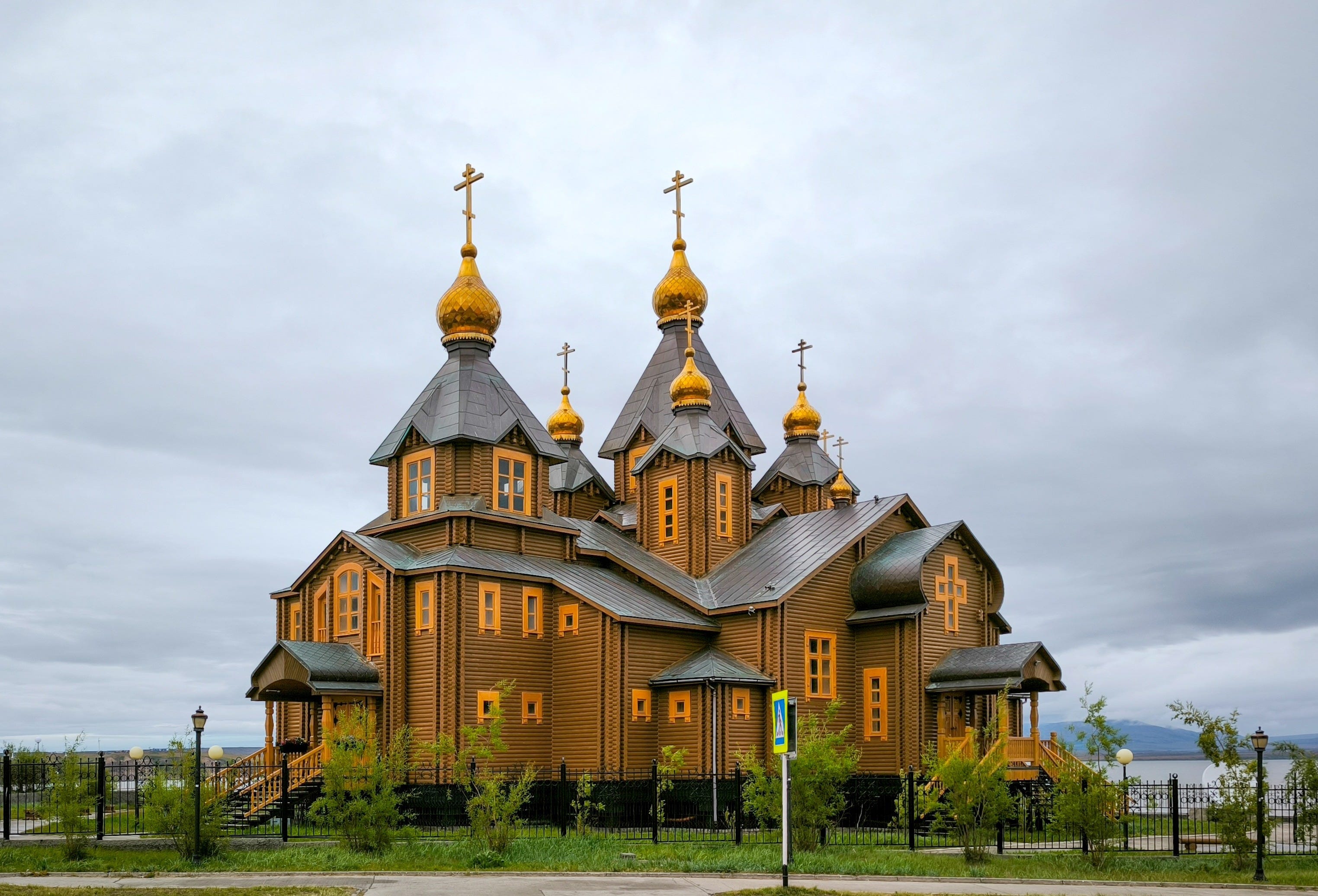
Port Kereku was later renamed Rytkheu in honour of the author’s legacy, and today, the museum is the city’s largest cultural institution. Not only is it a museum, it also hosts readings and presentations by authors from throughout Tunguska. It even has a residency programme for up-and-coming authors. It also has a traditional dance troupe that practices within its grounds — in a hall repurposed as a gymnasium — and several touring art exhibitions from foreign and local artists. “Rytkheu might be a small city by global standards,” said Galgannga, “but it definitely punches above its weight for arts and culture.”
Galgannga also brought us to attend a special poetry exhibition by some local literature majors. We were quite surprised to see that they were showcasing their work multilingually — not only in Chukchese, but also in Russian, Manjurese, Yezowese, Japanese, Swedish, and English. “We have a habit of translating ourselves for the world to better appreciate,” Galgannga said. “We take this from Rytkheu himself, who worked as an interpreter and diplomat before leaning into his writing career. He got to travel a lot with a trutchman passport like yourselves! That’s how he got into politics!”
Nearing the end of our time in Chukcha, we took another day to appreciate the beauty of the city and the warmth of its people — with Galgannga and Ryltune showing us many of their old haunts — before heading to take a train on the country’s only railway line up to Kargyryn. Despite being the capital, Kargyryn is only twice the size of Uelen, and it is mainly a bureaucratic capital, with the state institutions moved out of Rytkheu to make travelling to the capital of the country much more central and, in theory, more accessible. It is located at the mouth of the Yevam River valley, which is dotted by mining, fishing, and herding towns.
We said our goodbyes to Galgannga and Ryltune at the railway platform, thanking them for their generous hospitality and sending our regards to Zorawar, who we vowed to one day defeat in go if we would be lucky enough to share a yaranga with him out in the steppe again. The sisters sent us off with a container full of ikiilgyn for the road, included with many packs of soy sauce. “Whenever you want to come back, we will be waiting for you, as will your new mammoth friends!” Ryltune said.
Ahead of us were numerous meetings with the country’s tourism officials, and though they would be long and tiring, we were excited to explore ways for the Slow Foot Movement to help this country let its marvellous features shine through the polar fog.
FIELD NOTES
The flag of Chukcha consists of the national emblem in white over a field of blue. The national emblem is a sun with a polar bear at the centre, as the animal is featured in many of the country’s legends and myths. Thankfully, we never encountered one, though Zorawar had warned us about the formidable predator — it was the sole reason for why he had to carry his rifle while we were out in the steppe. The white symbolizes peace and the long winters of the north, which are both a struggle to survive against and a central part of Chukchese life. The blue symbolizes the endless sky of the country, which holds an important place as the home of the solar and lunar deities that form the centre of Tengric worship here.

Speaking of Tengric worship … Much like its neighbours in the rest of the Mongolo-Sinkanic cultural sphere, Chukcha blends the more esoteric practices of Vajrayana Buddhism with shamanistic Tengric epidoxy. Tengrism is the umbrella term used to link the various native faiths of the northern steppes. Chukchese Tengrism centres around the appeasing of ke’lets, spirits that can be beneficial or harmful, and it is well known abroad for its use of the fly agaric mushroom as an entheogen.
Chukchese is a lect of the Luorawetlanic language family. It is closely related to both Anianese and Tolmonese. The name for the family actually comes from the endonym of the Chukchese, lygoravetlet, meaning “the true people.” It makes use of the Soyombo script, which was brought over by Buddhist monks during the domination of various Yukagho-Mongolic and Turkic states. Created by the Khalkinese monk Zanabazar, its use was not widespread until its adoption by the Sakha Khanate, based in modern-day Saka. The territory that composes modern Chukcha, being a strategic trade route between Siberea and Hesperea and Thulea, was long fought over. This means that, despite the coming and going of empires, once various trading towns were established through the steppe, the maintenance of records by both merchants and monks became an extremely useful asset.
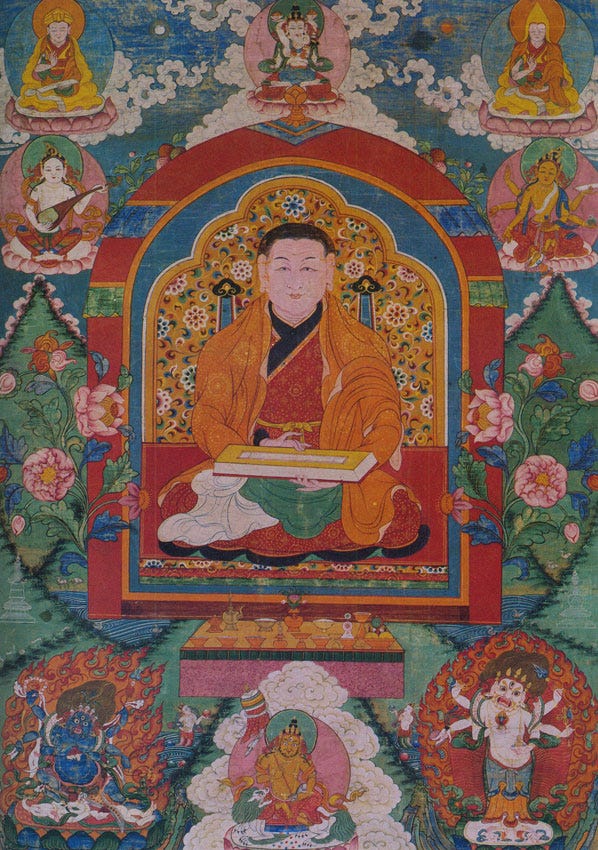
Most of the country’s population lives in cities and towns along the coast, reaping the benefits of the nationalized mining sector. Chukcha has a unique form of democratic socialism and welfare state that combines respect for the nomadic population and their traditional self-governing structures with the dominance of urban worker cooperatives in the economy. It is one of the most unionized countries in Siberea. It has traditionally held a policy of armed neutrality, threading the needle of Far Northern geopolitics carefully. In recent years, Chukcha has come into its role as a mediator between the interests of the Soviet Federated States, the Norwegian Union, the Serican Union, Chernorus, and the more Manjurese-aligned states of Kanchata and Tunguska. Unlike many of its neighbours, it did not experience the turmoil of corporate neo-colonialism that followed independence in a lot of the northern Siberean nations after the withdrawal of the SoN. Chukcha has the highest living standards of Siberea, outcompeting even Chernorus on several metrics, and is a growing tourist destination from people of all geopolitical spheres.
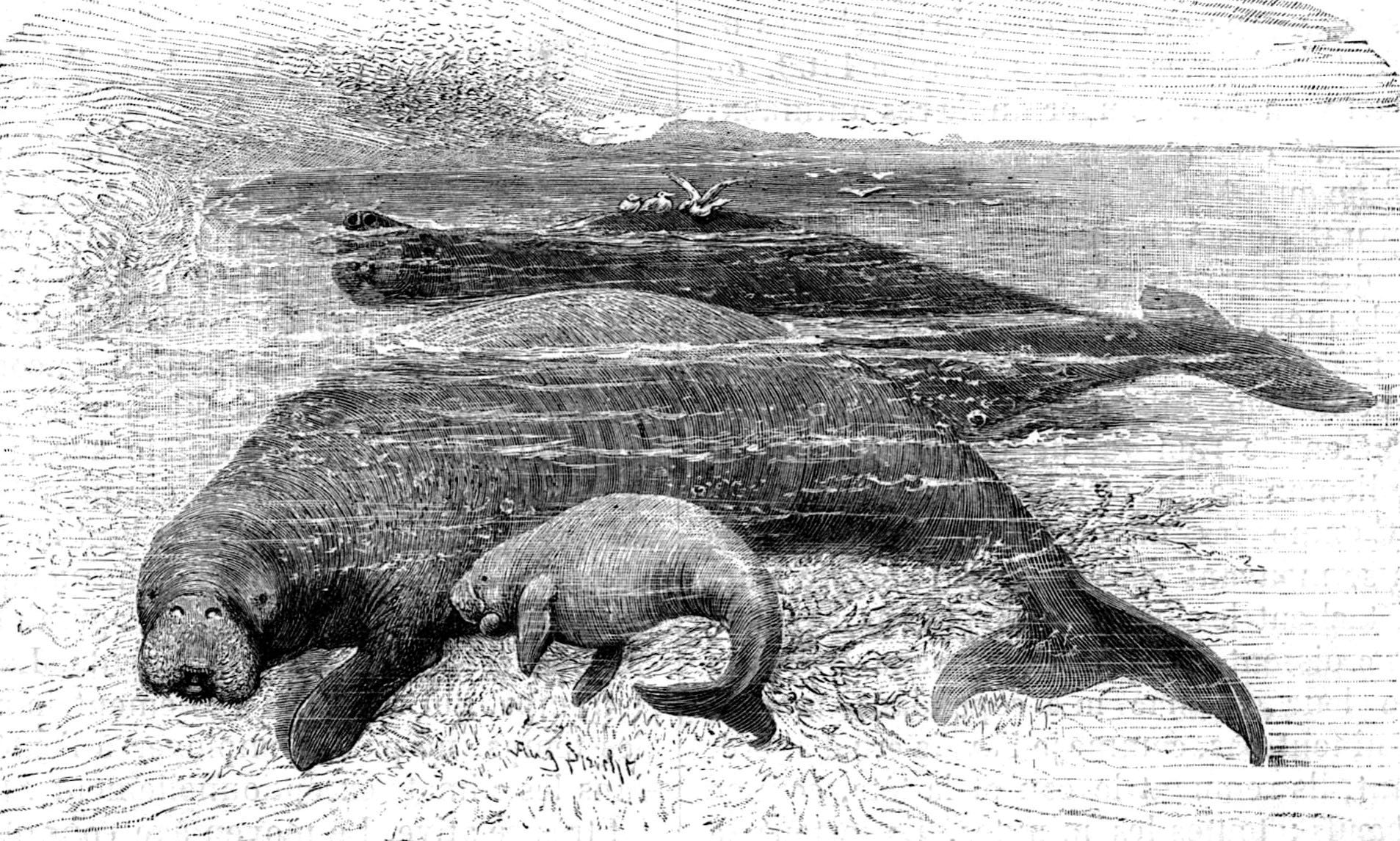


The oghat is a curious creature. It is essentially a cow of the sea. It is docile, easy to herd, and being a herbivore, much cheaper to raise than goons and rones, which the Chukchese also keep. The name for the domesticated subspecies comes from Old Tolmonese, ajtat, “to drive, to corral,” though possibly also directly from the Old Chukotkic aɣtat, also meaning something similar, like “to herd, to drive animals into a compound.” It is believed that oghats were domesticated shortly after goons, perhaps also by the Kerek-speaking forerunners of littoral Kanchata. The culture of herding oghats with kayaks seems to have come as a result of the Kerek having goons to help with the herding of the giant herbivores from one patch of seagrass meadow to the next. It is hypothesized that as oghats reproduce slowly, this made them a prized and sacred delicacy among the Kereks, who wanted to ensure they always had a source of the prized meat while wild populations continued to dwindle and become rarer along the main shores of Kanchata. Interestingly, the milk and milk glands of slaughtered oghats are the most prized part of the animals, as noted by the first European to have tasted the meat, Vitus Bering.