

Dispatch from HAIDA
Eclectic architecture; Sino-Wakasan chow; basketball and potlach; the Golden Spruce; totem pole raising; and more!

After a lovely time in my home country, we headed out with Quetzaltemoc to a very different part of the world. “I know you were hopping to head south,” he said, “but I’m going to Haida for work, and when do you get a chance to go somewhere like that with an old friend?” The offer was much too tempting! Despite earning our chops as globetrotters, we have never been to the Wakasan area of the continent. Not only is it an example of majestic temperate rainforests, but the place is known for its seafood, and as a foodie, I could never pass up that offer…
Dispatch
The trip up from Acapolco to Sghan, largest city in Haida, took the better part of a day. It involved changing flights twice in California, via Saticoy and then Kitsilano. Haida doesn’t have an international airport, but Sghan’s harbour is well connected by seaplanes to the rest of Wakasan, Uroryo, Alaska, and California. Soon there will be long-haul flights to Yezow, Nicaragua and America too. We landed early in the morning and adjusted our clocks a day, as the international date line crosses the continent just north of the California border with Wakasan. A day ahead, and a totally different hour system!
We meet Quetzaltemoc’s business contact and friend, whose name is Xhiina Qayahl-Llaanas Ilskyaalas Adiits‘ii, or Adiittsii for short. “Haida names are so long that even we have trouble with them!” he said. He explained that the first part of the name is his birth-place, then it is the name of his clan, followed by his family name, and then finally his personal name.
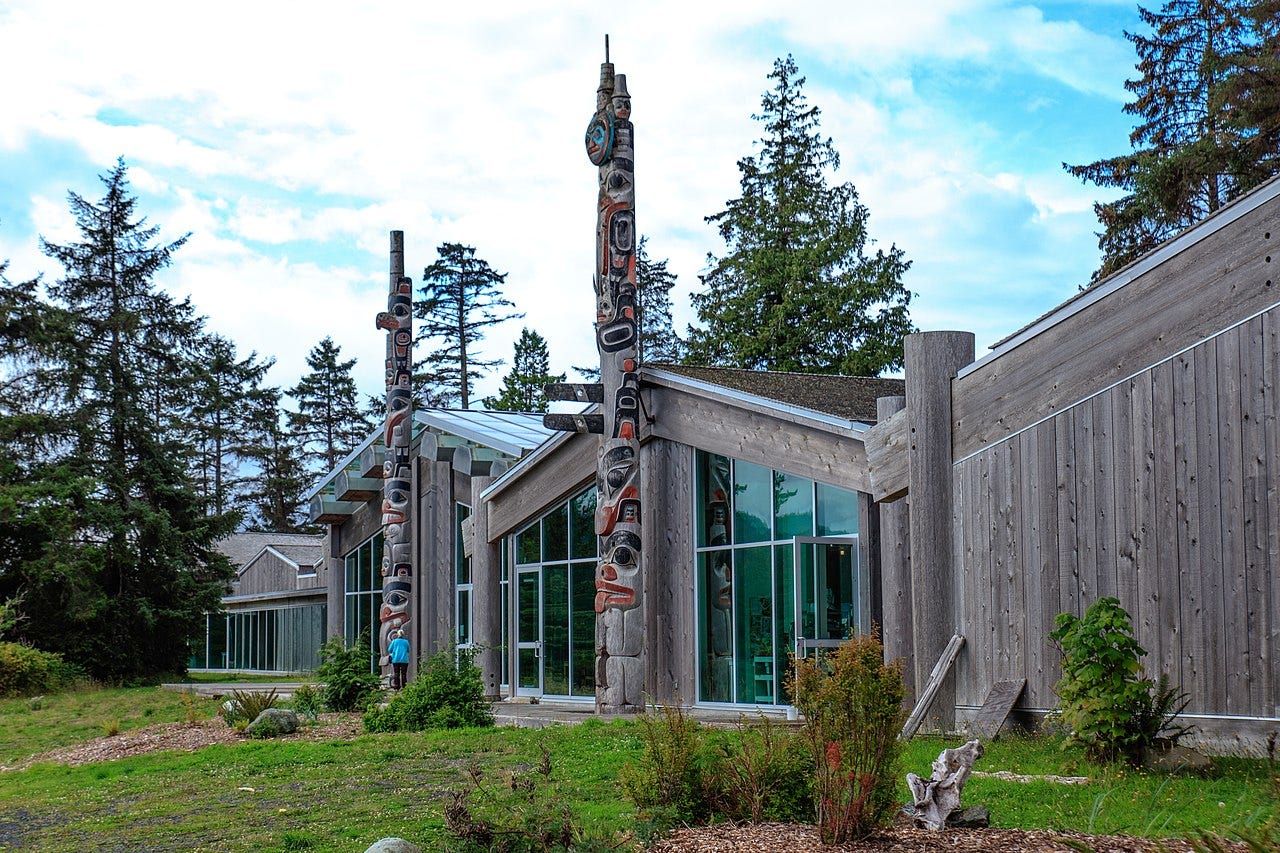
As we drove into Sghan, we were amazed by the architecture. The nations of Wakasan place a great importance on the sea, and Haida is no exception. All stately and historic buildings are within the waterfront. Being the biggest city, Sghan’s waterfront includes long, palatial wooden longhouses that have been here for ages. Yet, a block inland and you find less traditional structures: row-house midrises with traditional totemic facades. These unique buildings combine Art-Deco, Georgian, Victorian, and Meiji architectural styles blended with traditional aesthetics, having been largely built during the Japanese colonial period, which saw rapid industrialization.
Some of this was part of the larger move within Japan-controlled territories towards Eclectic Architecture in the early 20th century, combining old motifs with imported construction methods. “But really it began before Japan entered the scene,” said Adiittsii as he parked the car and led us towards the beachside boardwalk to get better views. Pointing to the Georgian motifs, he said, “Those come by way of American and British merchants, when they were trying to get a cut of the transoceanic trade controlled by the Yezowese Humsa League.” So it seems that though the idea might have been promoted by Japanese administrators to deal with the booming population, the locals here have already been innovating and borrowing from outsiders in their own way for ages.
We also learned that each of these buildings is socially run, but they are financed and maintained by clans. “Housing is very communal here,” said Adiittsii. That translates as cheap housing.
“And an incentive to keep the place tidy!” added Quetzaltemoc.
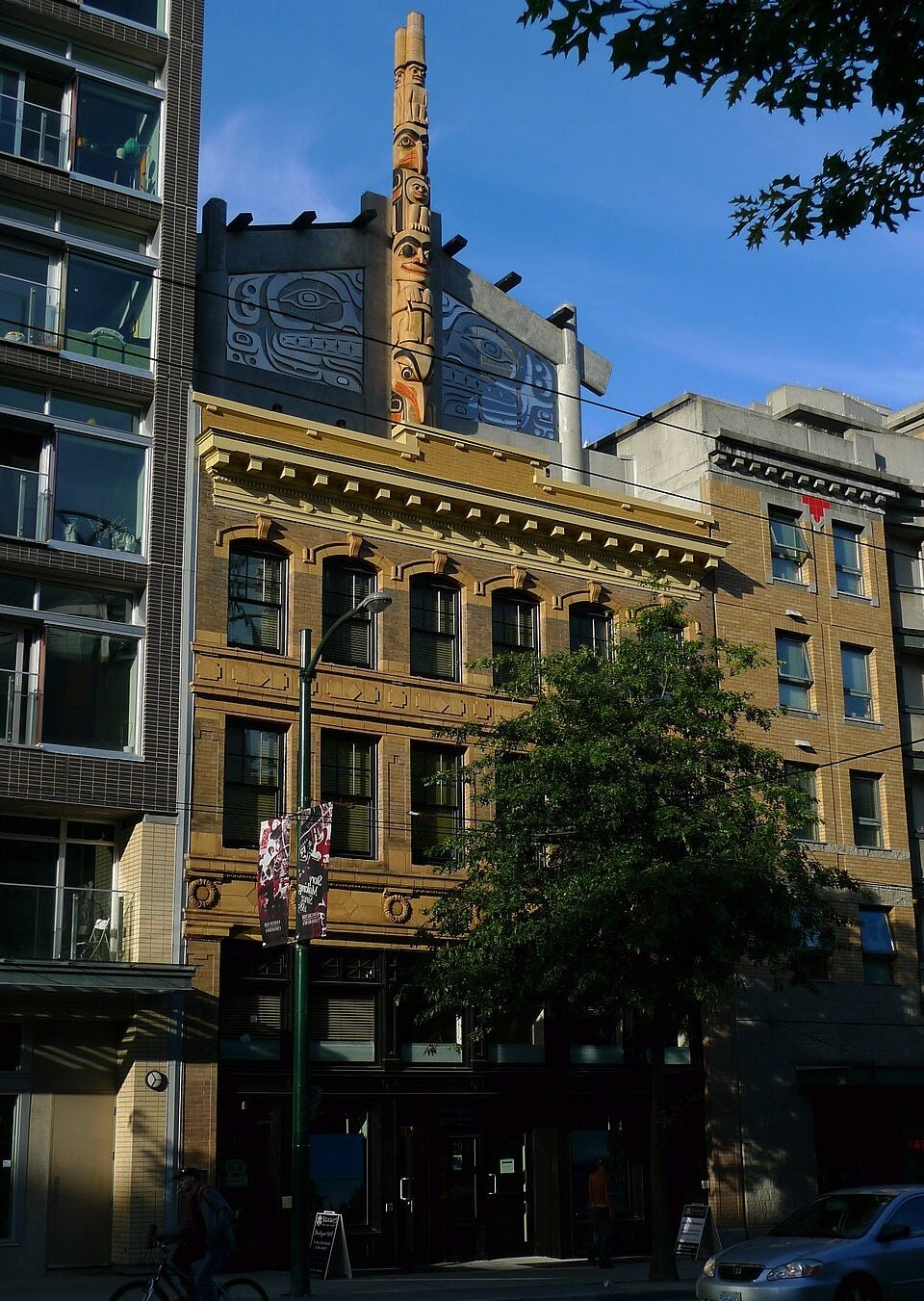
We then dropped our luggage in a small-apartment in the Qayahl-Llaanas building, with its gorgeous facade and totem pole. While Quetzaltemoc pursued their buisness matters, we went to our meetings with our own contacts for the tourism industry in Haida. Interestingly, as neither of us speaks Haidanese or the common lingua franca, Yezowese, we had to rely on a translator who knew English, and who better than Adiittsii! The next few days were a blur of enjoying amazing nightlife in Sghan with Quetzaltemoc in between hectic meetings. We got to try Sino-Wakasanese cuisine during this time, enjoying fishes like cockle ramen, fried lingcod in orange sauce, halibut dumplings, and the dish known as Boston fried rice — which, ironically, included mostly local ingredients like smoked clams, barbequed goon meat, shrimp, and crab roe. Quetzaltemoc ended up needing more time to finish his work in the city, so we decided it was best to part ways so that we could go with Adiittsii to get to know the rest of the country better.
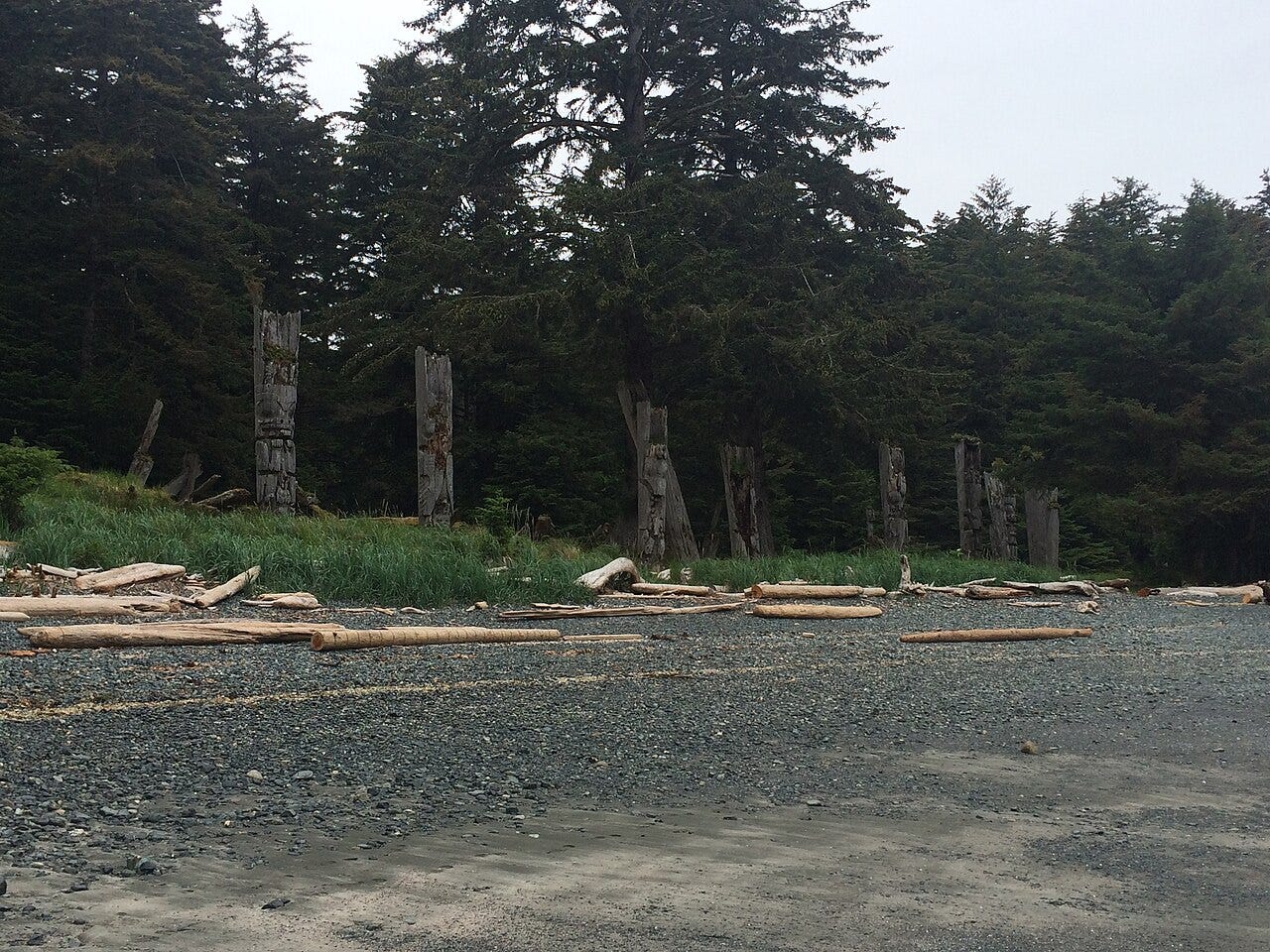
Our first stop was an overgrown village known as Ghuuski. “This was one of the last places smallpox ripped through in the 19th century,” said Adiittsii. Indeed, life in Haida from the 17th century onwards was routinely disrupted by waves of disease brought by Yezowese and later European traders. Though the initial waves decimated the area, the population had fully recovered to pre-contact numbers by the 18th century and was rapidly growing thanks to introduced root vegetables like the potato. The colonial Japanese period made the population grow even more rapidly, coinciding with the time that engerst — also known as Kawaisuu rice or Hordeum jubatum — became more domesticated and widely eaten. Some villages like Ghuuski, however, never recovered. The last wave of smallpox was in 1862, right before the Japanese takeover, and survivors chose to move to Sghan instead of rebuild. Rather than allow it to be forgotten, the Haidanese have turned it into a monument to the lives lost and to the nation’s resilience. There is a museum built at the entrance of the village with life-sized models too.
We then stopped for food at a nearby village called Jiihlinjaaws. Inside the only restaurant there, we made a fortunate encounter with an elder of local fame. “My name is Ghandl, like the great one before me, known to the Bostonman by a Mr. Swanton,” he said in lightly accented English while holding a hand over his heart. He invited us to join him for a cup of tsawtsah, tea with euligan grease — also known as candlefish oil — and salt. Over the Tibetan inspired drink that has fed the Wakasanese for generations, our host tells us about how he lost his vision in his youth and dedicated his adult life to learning and transmitting the poetics of his culture to the new generations. Apart from performing in local events, he also performs at the nearby Museum of Ghuuski. He then invited us to listen to his performance that night. “If time allows you,” he said.
That evening, as Ghandl walked to the spotlight in his iconic dajáng — woven out of yellow cedar bark — and started his tale, I was reminded of the long history of Haidanese storytelling. Since early contact, foreigners have been amazed at the beauty of the oral literary traditions in these isles. We are treated to an exquisite performance of Goose Woman and the Headman’s Son. Adiittsii helped translate every few lines into English. Like many Wakasanese myths and tales, this story centres on a journey into the otherworld, represented by the inland forests that tower over the settled, sheltered coves. Haidanese poetry is considered one of the great performance poetry traditions of the world, up there with nabati of Algeria and the pantun of the eastern Emporic Rim. Unfortunately, it is one rarely talked about outside of scholarly circles and the long connected cultural realm the North Pacific.
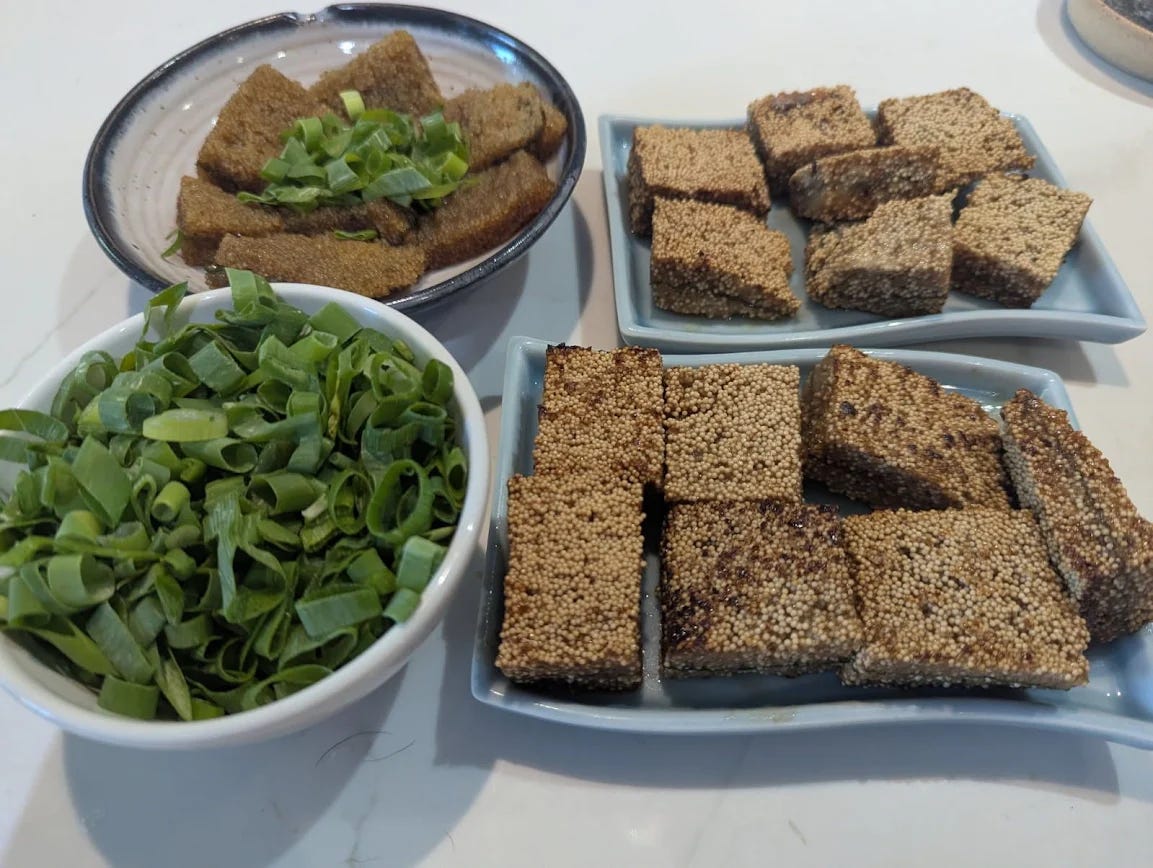
The next day, we continued our journey to our final stop, the Golden Spruce, known as the Kiidkkyaas, or the “Ancient Tree.” We drove up to the town of Llaanas by Lake Ghawaay Qaahli, an inlet that opens up into the heart of the country a few miles south of the country’s second largest town and unofficial northern capital, Ghawdaghaaxhiwaas. After sleeping for the night and waking up early the next morning, we treated ourselves to a lovely breakfast at a local cafe. We had mashed wapato, herring roe, fried razor clams and roasted butter clams sourced from the local clam garden. As directed by Adiittsii, we dipped it all with euligan grease and soy sauce, as is the local flavour that defines Haidanese cuisine.
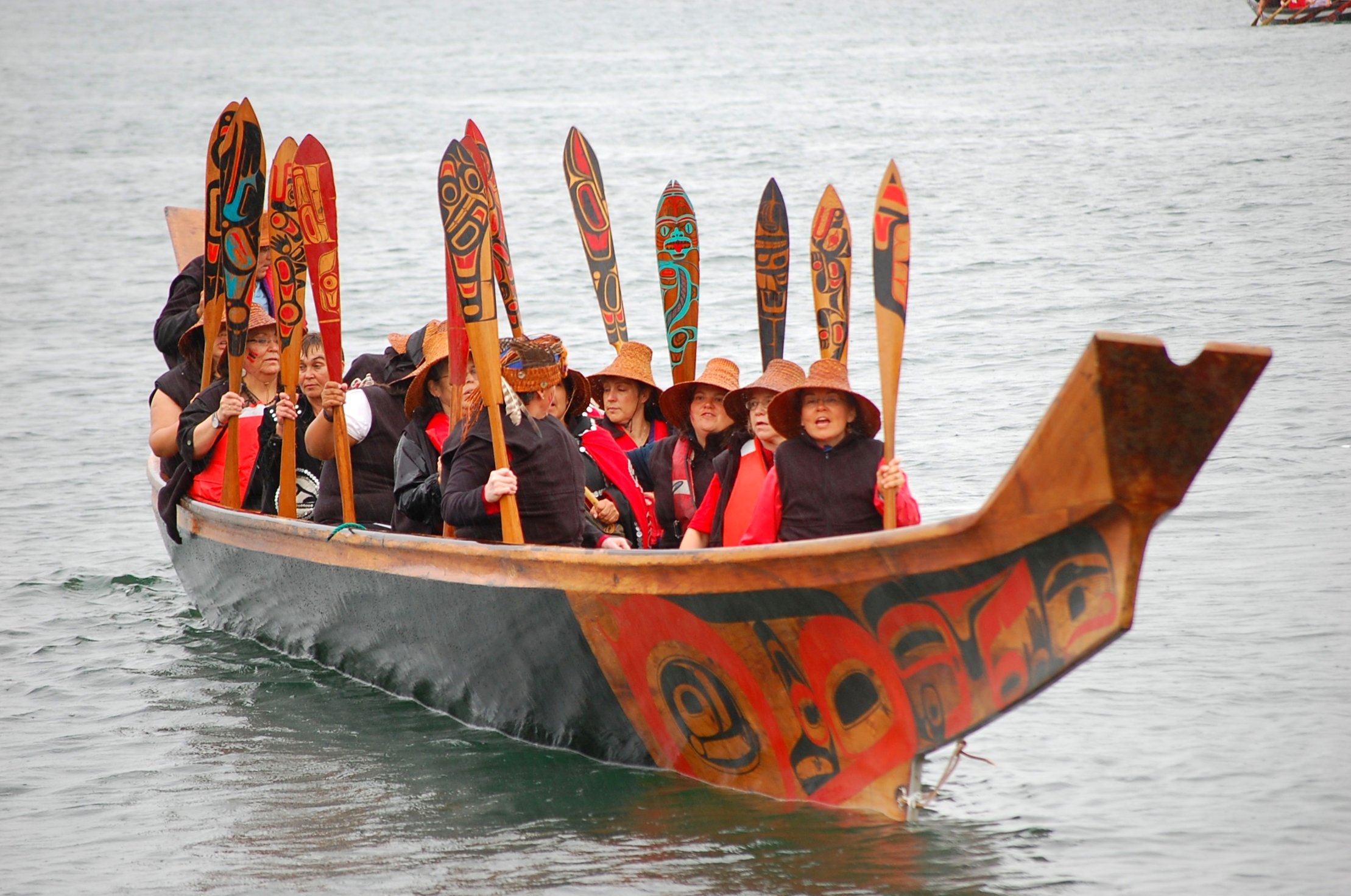
We then hired a dugout canoe to go down the inlet and up the Yaaguun River, which hosts at its shore the amazing living monument, a giant of a tree that should, for all intents and purposes, not have been able to get this large. You see, the mutation that causes this tree’s needles to be golden rather than green should be, in this oceanic, overcast clime, a deep disadvantage. This is even something that has been studied, as SoN-sponsored scientists attempted to grow saplings from cuttings of the tree in the 1950s. The low sunlight in the northeast Pacific coast, however, makes it unlikely a spruce with this mutation would have survived to grow this large! The Kiidkkyaas is also an important figure in Haidanese traditional religion, which is grouped by scholars as part of the regional religious complex of interrelated epidoxies known as Kamuyism. In this belief system, the Golden Spruce was a boy who had caused a storm to descend upon his village. Despite being warned not to look back as he fled the disaster, he did, turning into the great tree immediately.
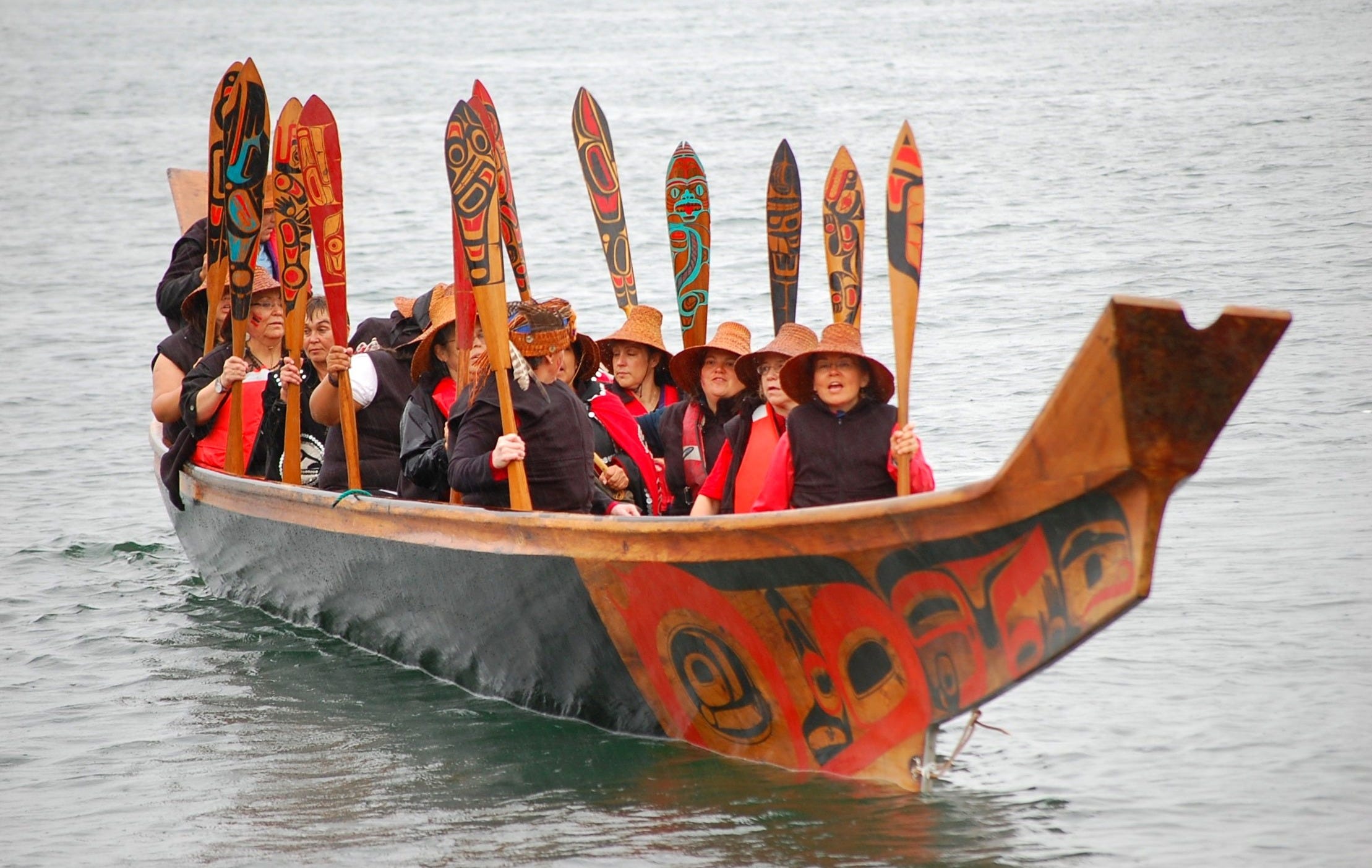
On the dugout canoe, Adiittsii explained that, during the aftermath of the Second World War, the Americans led the SoN occupation of the islands. Soon after, the Qaysun Riot exploded in the summer of 1950 in protest of the American imposition of martial law. The strength of the pro-independence movement led the Americans to step down from their leading role in Wakasan, and a joint native civilian and SoN administration supported by Yezow, Nicaragua, and Peru took control. Urban legend has it that the Americans, looking to break the spirit of the Haidanese, had planned to fell the Golden Spruce, one of the most important symbols of the country. The idea was so outrageous and barbaric that it was laughed out of the room by the representatives of the other countries, and the United States soon relented in their heavy-handed approach. Whether or not the story is true, it reflects the deep suspicion that the Haidanese held for the American occupiers of the era, seeing them as unwelcome interlopers that had frustrated their growing independence movement after the fall of the Japanese colonial empire. Thankfully, the Kiidkkyaas still stands, and remains a symbol for Haida accross the world.
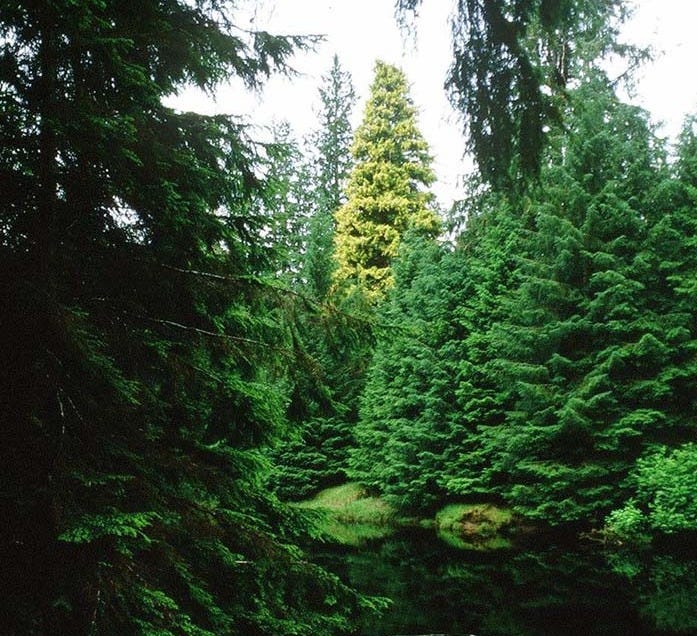
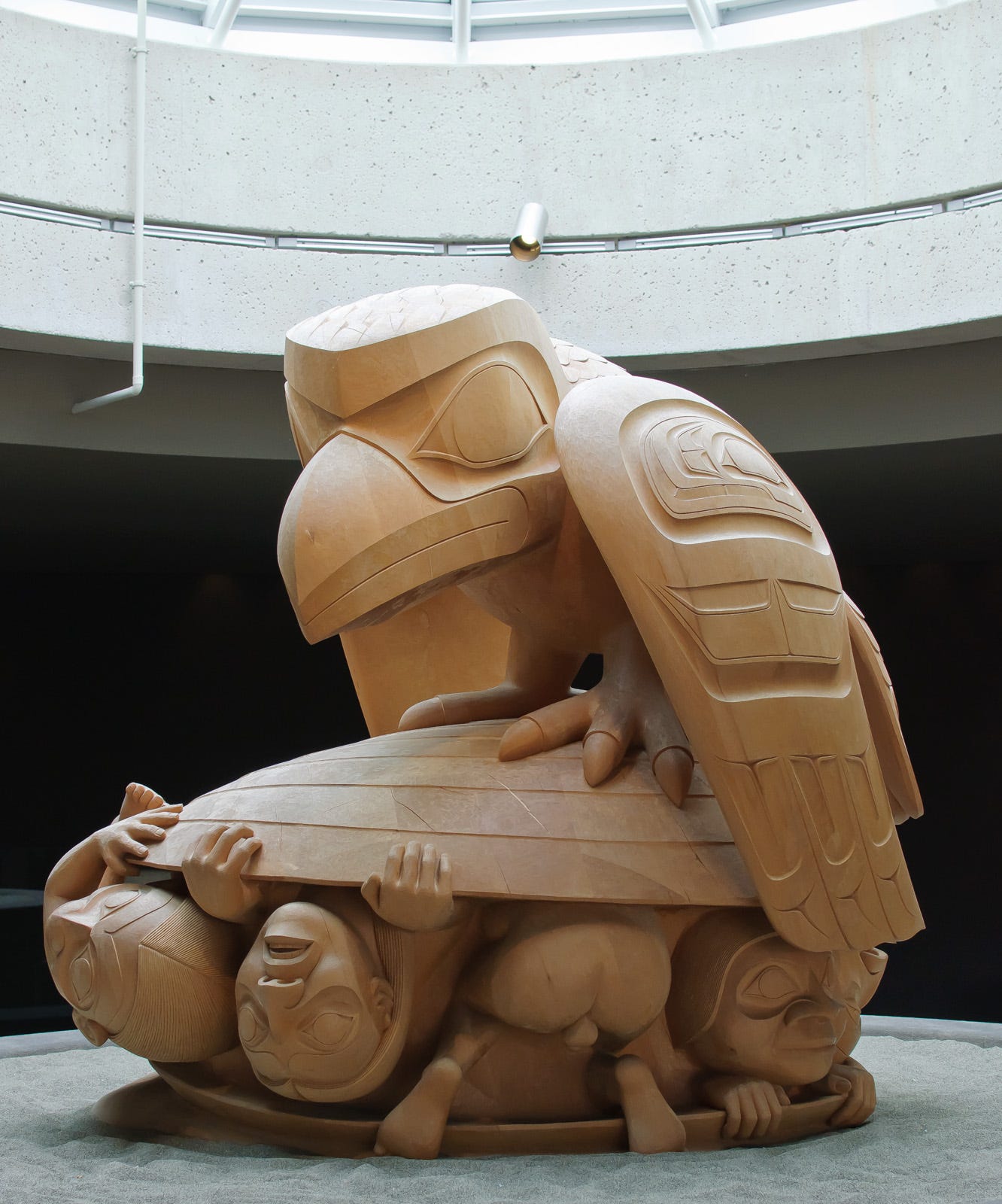
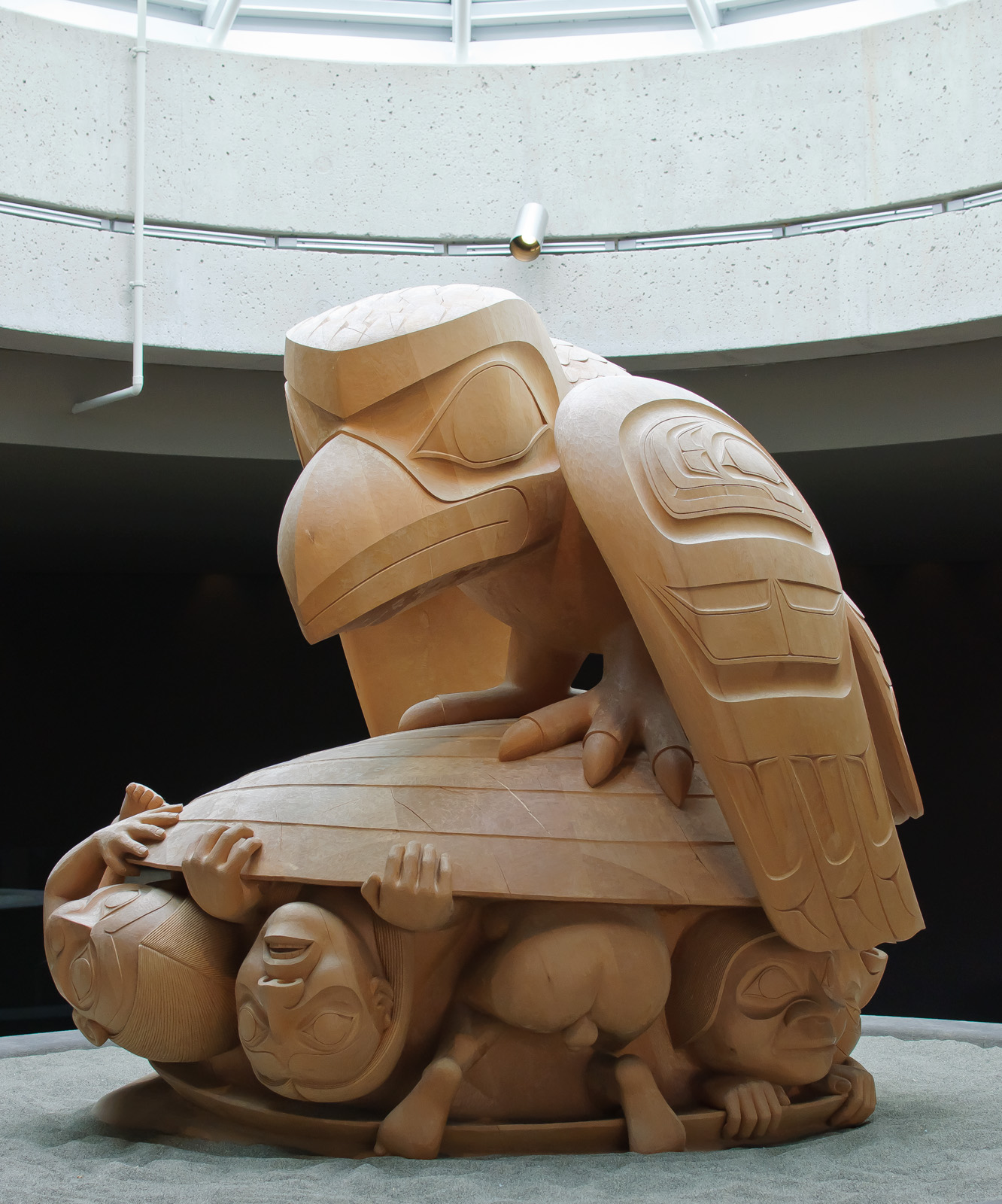
On our way back to Llaanas, Adiittsii admitted he had one last thing to show us! The village was in the process of erecting a brand new totem pole, and we were there just in time to meet the visiting master carver, Ghudsanglas, known for his totem poles that decorate many a town across these isles. Known locally as gyaaʼaang, these monumental wood carvings are erected for important commemorations and events. In this case, the one that Master Ghudsanglas was working on is a memorial to the local village chief, who had passed nearly a year before our visit. “When this pole is done, it will be raised by traditional methods,” Adiittsii explained. And sure enough, were lucky enough to experience this firsthand! We joined a mass of locals in dugout trenches and all pitched in some elbow grease to raise it whilst using ropes and cross beams to steady the massive structure. In no time, it was upright and ready to be stabilized with rocks and soil filled into the trenches.
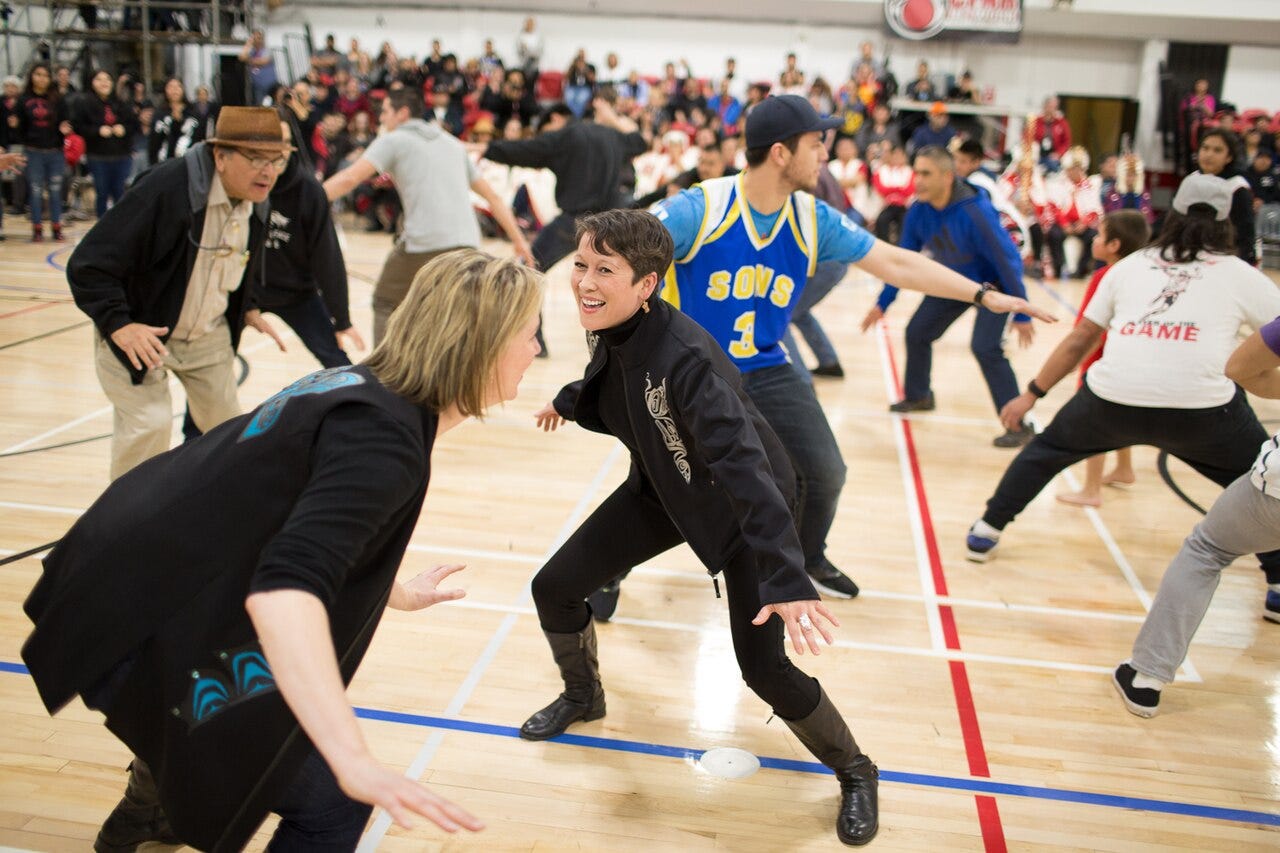
Immediately after, we were invited to a potlatch. This is a ceremony practiced throughout Wakasan, where local leaders engage in the ritual gift-giving of wealth, resources, rights and the strengthening of communal ties. This was then accompanied by dancing and signing, and at the centre of it all was a basketball match. We were told that every village, no matter how small, has a basketball court. “It’s an all weather sport,” Adiittsii said. “Plus, it allows the elders to have a an excuse to all get together and cover major topics of business.”
The poles are meant to last sixty to eighty years, until the generation that made them is gone. This ephemerality is considered one of the sacred and important virtues observed by the largely Vajrayana locals, and their ritualistic dismantling once they have become a hazard has come to be a syncretic religious tradition as well, much like the sand mandalas of Siberea and Serica. We extended our stay a few days longer, as the master wood-carver and his patrons invited us in a show of true Haida hospitality. Apologies, as this does mean that this dispatch had to be published a bit later than expected!
While hanging out with locals, we got to taste the local delicacy of naaw, a liquor that was infamously traded by the Yezowese and Russians in Wakasan. This is made from sarana, a tuber that superficially resembles clumps of grain, and which was little used in Wakasan before the Yezowese introduced the technology of distillation. After enjoying a proper authentic potlatch, we made our way down to Shigagirta, the political capital of the nation, lying halfway between Sghan and Ghawdaghaaxhiwaas, and did a few more days of political hobknobbing, before heading out to our next destination.
Field Notes
Haida is an old nation. Its prosperity, however, came from more recent days of trade. It was the Humsa League’s seasonal umsa or tributary missions from the other side of the Pacific that would link Haida and the rest of Wakasan with the riches of Serica. It grew rich from trading euligan with the Yezowese, and later from providing sea otter fur to satisfy the Qing market, as well as monumental timber with Japan.
Sghan was once known as one of the Four Great Ports of Wakasan, alongside Kaasdaheeni in Sitka, Chihatriji in Sechelt, and Yaguy in Chalnulth. Each of these ports was associated with a different European power during the Incursion Era, that period in Hesperean history just before the Japanese conquest of Yezow. As the Humsa League’s influence waned, the Russians ventured from Siberea to Sitka and the British went overland across Thulea to claim a foothoold in Sechelt, while the Flemish struck up a trade relationship with Chalnulth, and the Spanish and later Americans pursued trade with Haida. Many a good made its way into Haidanese potlatches, from Chinese silk and porcelain to Mayan jade and Peruvan silver. Ironically, after the fall of the Spanish Empire, Nicaragua retained the old trade relationship with Haida and the rest of Wakasan that Azlana would eschew, with ships coming up from Acapolco instead of San Blas. And yet, the Yezowese language, a relict of the initial Humsa League period from the 17th to the 19th centuries, remains the tongue of trade in the region.
_-_Graham_Island_-_scenes_around_the_Haida_Heritage_centre_-_the_museum_buildings_-_(21533671266).jpg)

.jpg)

.jpg)
The Haidanese practice the Vajrayana school of Buddhism, and humble monasteries dot the interior, offering isolation from the urban fabric that sprawls the nation’s coasts. Unlike most other Vajrayanans,t however, the monks of Hesperea are the principal producers of alcoholic beverages in the region, a tradition adopted from largely Mahayana Japanese monks. In parallel, the Wakasanese also practice their own traditional religions — viewed by outsiders as epidoxies — and take great pride in the survival of indigenous beliefs. Few locals would mention being Buddhist, associating the term with monkhood or being ordained clergy of some sort. Yet, plenty celebrate Losar — the Vajrayana New Year — in very similar ways to their counterparts on the otherside of the Pacific. Buddhist rites are not an uncommon inclusion in life stage ceremonies, such as funerals, which were readily adapted as the Haidanese already practiced cremation. Haidanese also hold fiercely to their own ceremonies, traditions, and taboos that get classified with those of neighbouring peoples under the umbrella of Kamuyism, each with their own distinct features and pantheons.
The national language, Haidanese, is a language isolate, with the standard variety being a merger of the northern and southern dialects, though spoken with the prestige accent found in Sghan. The Junso script is used to write the language. It was first used by Yezowese traders to record tributes, adopting features from the Todo script of the Manjurese-speaking Qing dynasty. Buddhist monks also started to use it to record local stories, becoming some of the earliest ethnographers. Until the 20th century, however, the orthography of the Haidanese and most other Wakasanese lects had remained fossilized, using the simplified Classical Ainu pronunciation from the early 17th century. With independence, new letters and digraphs were introduced to make the script more phonetic, and to improve literacy rates. Today, only the exonyms of the capital city Shigagirta continues to use the old transcriptions, as well as a few languages such as Spanish and Russian, where the name of Haida is based on the Yezowese transcription Haidamosir — Jaydamorcia and Гайдамозрия.

The flag of Haida is a white emblem on a red background, using the dovetail shape found throughout the North Pacific Rim. The red symbolizes the red cedar trees that dominate the country’s landscape and which form an important source of textiles, including the ever-present cedar bark cloaks the people here wear to protect from the rain. The emblem itself is done in the traditional Wakasano-Salishic Style, found up and down the coast all the way to Bellacoola. The Eagle and Raven on it represent the two moieties of traditional Haida society, to which all clans belong, and their intertwining represents the resilient and indivisible nature of the Haidanese.
I looked up what happened to Kiidkkyaas in OTL. It was a mistake. Now I'm sad again, just like after Nicaragua.
Another awesome and interesting read! Thankyou for taking us with you CC Winter